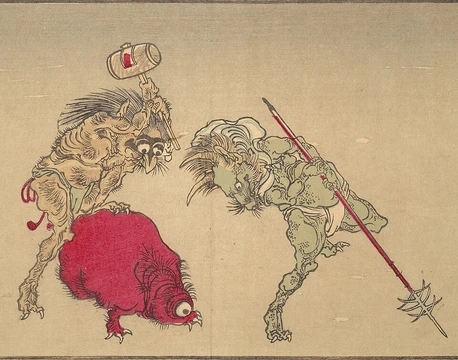
Frequently Asked Questions
The most-asked questions about yōkai in popular culture.
What exactly are yōkai in popular culture?
Yōkai are supernatural creatures drawn from Japanese folklore that appear across anime, manga, film, and games, ranging from mischievous shapeshifters to malevolent spirits. In modern media they serve as protagonists, comic relief, or terrifying antagonists depending on the story's tone.
What's the difference between 'yōkai,' 'yokai,' and 'youkai'?
They are all romanizations of the same Japanese term (妖 or 妖怪), just following different transliteration conventions. The macron in 'yōkai' marks a long vowel, while 'yokai' and 'youkai' are common English approximations you'll see on merchandise and in English-language titles.
Who is the most iconic yōkai character in popular culture?
Kitarō, the half-yōkai protagonist of Shigeru Mizuki's GeGeGe no Kitarō, is widely regarded as the face of the genre. His 1960s manga and its multiple anime adaptations made him a household name in Japan and the default reference point for Western fans encountering the subject.
Where should a newcomer start with yōkai media?
The 1996 or 2007 GeGeGe no Kitarō anime series offer the most accessible introduction to classic yōkai lore and character design. For a lighter, more episodic entry point, the anime and manga Yōkai Watch or Yōkai Apartment are friendly starting choices.
How are yōkai different from oni?
Oni are a specific category of large, horned, demon-like beings in Japanese mythology, while yōkai is the broader umbrella term covering all supernatural creatures. In most modern media oni are treated as a subset of, or a closely related class to, yōkai rather than a separate system.
What are some of the most recognizable yōkai types?
The kappa (a water-dwelling creature with a dish on its head), the tanuki (a shapeshifting raccoon dog), and the kitsune (a nine-tailed fox spirit) are among the most frequently featured. Each carries distinct folklore traits that writers adapt for comedy, horror, or drama as the story demands.
What is GeGeGe no Kitarō and why is it so significant?
It is Shigeru Mizuki's long-running manga, first serialized in 1960, following a young yōkai who inherits his father's role as guardian of the spirit world. Five anime adaptations, live-action films, and a dedicated theme park make it the single most influential yōkai property in Japanese pop culture.
How do yōkai in Japanese media compare to Western supernatural creatures?
Yōkai tend to be more fluid in form and motivation, often blurring the line between animal, ghost, and deity, whereas Western folklore more rigidly separates vampires, werewolves, and ghosts into fixed categories. Japanese yōkai stories also frequently emphasize coexistence and negotiation with the supernatural rather than outright destruction.
What are some notable modern yōkai titles beyond Kitarō?
The Yōkai Watch franchise (games, anime, and manga) introduced the concept to a global generation of children throughout the 2010s. In a darker register, works like the anime Mononoke and the manga Jigokuraku (Hell's Paradise) draw on yōkai aesthetics for more serious, horror-adjacent storytelling.
Is there a fixed 'canon' for yōkai, or do they change by creator?
There is no single governing body; each author reinterprets yōkai freely while drawing on a shared folklore vocabulary. This is why a kappa might be a slapstick fisher in one manga and a deadly territorial guardian in another, and both versions are considered perfectly valid.