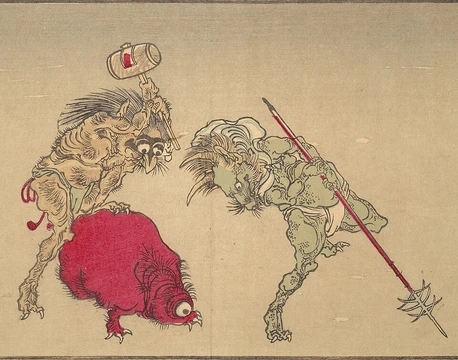
Demon Pond (2005 film)
Filmed stage production of a 1913 play, directed by Takashi Miike.

Wikipedia / Wikimedia Commons
Demon Pond (夜叉ヶ池, Yashagaike) is a 2005 filmed stage production of a play by Keishi Nagatsuka, itself based on a 1913 work by Izumi Kyōka. Directed by Takashi Miike, the production was recorded in front of a live audience and came out on DVD in Japan on May 25, 2005. This marked Miike's first venture into directing for the stage.
The story follows Gakuen Yamazawa, a man from Tokyo who stops in a mountain village after a summer field trip. The village’s only stream comes from Demon’s Pond, which locals believe holds a dragon and whose water they consider poisonous. There he meets Yuri Hagiwara, who asks him to tell her a story. His second tale upsets her, and she tries to send him away, but her husband Akira wakes up and welcomes Yamazawa, an old friend from Tokyo.
Akira had left Tokyo to collect stories from the countryside but feels he has become part of one himself. He is now responsible for ringing the village bell at matins, vespers, and the mid-watch of the night, a duty he took over from a dying seventy-nine-year-old man named Yatabei, who had done it for fifty years. The task is based on the belief that if the bell is not rung at the correct times, water from Demon Pond will flood the populated Kotohiki Valley beneath Echizen's Three Province Peak. Akira now calls himself Yatabei, has married Yuri, and refuses Yamazawa’s pleas to return to Tokyo. Yamazawa decides to climb to Demon Pond, and Akira goes with him, leaving Yuri to ring the bell.
From Demon Pond, the giant crab Kanigoro and the carp Koishichi are sent by Lady Myriad, nurse to Dragon Pond’s Princess Shirayuki, to tell the villagers there will be no rain despite their offerings of broken pottery and the heads of cats and dogs. Koishichi explains that the princess loves the prince of Serpent Pond by Sword Peak at the foot of Mount Hakusan, but if she flies to him, it will cause a flood that kills the villagers. She stays at Demon Pond as long as the bell is rung at the proper times.
A catfish priest named Black, representing the prince of Serpent Pond, brings a letter from the prince to the princess. He received the order while imprisoned and fears the letter might instruct the princess to eat him. Kanigoro cuts the small letter box open, but it contains only water.
Lovesick Princess Shirayuki is determined to visit the prince, but Lady Myriad reminds her that her ancestors made a vow: s
- Directed by
- Takashi Miike
- Based on
- 1913 play by Izumi Kyōka, adapted by Keishi Nagatsuka
- Released on DVD
- May 25, 2005 (Japan)
- Genre
- Filmed stage production
- Music by
- Kōji Endō
- Cast includes
- Shinji Takeda, Tomoko Tabata, Ryūhei Matsuda, Yasuko Matsuyuki
Lore & Background
The story follows Gakuen Yamazawa, a man from Tokyo who passes through a mountain village and meets Yuri Hagiwara and her husband Akira, an old friend. Akira has taken on the duty of ringing a bell at matins, vespers, and mid-watch to prevent the waters of Demon Pond from flooding the valley. The pond is believed to be home to a dragon princess, Shirayuki, who is in love with the prince of Serpent Pond but remains bound by an ancestral vow as long as the bell is rung.
Reader's Guide
Demon Pond is notable as Takashi Miike's first stage production, showcasing his versatility across genres. The film blends humor and drama, with the first half described as more humorous and the second half more dramatic. Reviewers praised the acting as mesmerizing and noted Miike's ability to adapt within any genre. The production features a musical score by frequent Miike collaborator Kōji Endō. The DVD release includes an interview with Miike as a special feature.
Did You Know?
- Demon Pond was Takashi Miike's first stage production.
- The musical score was written by Kōji Endō, who had previously worked with Miike on over 20 films.
- The DVD was released in Japan on May 25, 2005, and contains an interview with director Takashi Miike.
- The play was originally written by Izumi Kyōka in 1913 and adapted by Keishi Nagatsuka.
Literary Lineage & Stage Origins
Demon Pond traces its roots to a 1913 theatrical work by the celebrated Japanese author Izumi Kyōka, whose original play established the mythic and folkloric framework that would later be reimagined. The story was subsequently adapted into a stage play by Keishi Nagatsuka, who reshaped the material for a new generation of performers and audiences. Director Takashi Miike then brought this theatrical version to the screen in a distinctive format: rather than shooting a conventional feature film, he filmed a live stage production performed before an audience. This hybrid approach preserved the immediacy and energy of live theater while capturing it for a wider viewership. The resulting DVD was released in Japan on May 25, 2005, offering fans and scholars a rare glimpse into how Miike interprets classical Japanese drama through his signature directorial sensibility. The project sits at the intersection of literary history, live performance, and cinema, making it a uniquely layered artifact in Miike's extensive filmography.
Narrative Architecture & Thematic Layers
The plot weaves together multiple narrative threads that interlock like the gears of a mythic machine. A Tokyo professor named Gakuen Yamazawa stumbles into a remote mountain village where the sole water source, Demon's Pond, is believed to harbor a dragon and poison the stream. There he encounters Yuri Hagiwara and her husband Akira, who has abandoned his freedom to ring a sacred bell three times daily—a duty inherited from a dying elder named Yatabei who held the post for fifty years. The bell keeps the dragon princess Shirayuki imprisoned, for her love of a prince at Serpent Pond would unleash a catastrophic flood. Creatures of the pond—a giant crab, a carp, and a catfish priest—deliver prophecies and letters, while the villagers, desperate for rain, plot to sacrifice Yuri to an ox. Yamazawa, revealed as a Honganji priest and Tokyo University professor, denounces their outdated traditions. The tragedy culminates in Yuri's suicide with a scythe and Akira's subsequent self-slaughter, after which Yamazawa assumes the bell-ringing role, perpetuating the cycle.
Production Context & Musical Partnership
Demon Pond marked a significant milestone in Takashi Miike's career as it represented his very first foray into directing a stage production. The experience proved to be a stepping stone, as his next theatrical project, Miike Takashi × Aikawa Show: Zatoichi, was filmed in 2007 and released on DVD the following year. The musical score was composed by Kōji Endō, a longtime creative partner whose collaboration with Miike stretches back to the late 1990s. Their shared body of work spans an extraordinary range of genres and tones, encompassing titles such as Rainy Dog, Full Metal Yakuza, Audition, Dead or Alive, The Happiness of the Katakuris, Gozu, One Missed Call, and Izo, among many others. The cast assembled for this production featured Shinji Takeda as Akira, Tomoko Tabata as Yuri, Ryūhei Matsuda as Yamazawa, Yasuko Matsuyuki as Princess Shirayuki, Ken'ichi Endō in a dual role as the Giant Crab and a Representative, Kitaro as the Catfish and Takuzen, and Tetsurō Tamba as Yatabei.
Reception & Home Media Release
The filmed performance reached Japanese audiences on DVD on May 25, 2005, and the disc included an interview with Takashi Miike as a special feature, offering viewers a behind-the-scenes perspective on his approach to adapting the stage material. Critical responses, while limited, tended toward appreciation. Björn Becher of filmstarts.de awarded the production three out of five stars, noting a tonal shift between its halves: the first act carried a lighter, more humorous energy, while the second descended into heavier dramatic territory. Michael Den Boer of 10kbullets.com offered a more effusive endorsement, comparing the work to a rare flower which begs to be seen by a larger audience, suggesting that the production's particular qualities—its blend of folkloric storytelling, theatrical immediacy, and Miike's directorial vision—deserved broader recognition beyond its initial Japanese release. The modest critical footprint underscores the niche appeal of filmed stage productions, yet the reviews collectively affirm that Demon Pond resonated with those who encountered it, standing as a distinctive entry in Miike's prolific and genre-defying career.
More in Yōkai in popular culture 1-19
Spotted an error? Know more?
This is a living reference — every entry is fact-audited, and reader corrections feed straight into our audit queue. Suggest an edit · See this site's audit record