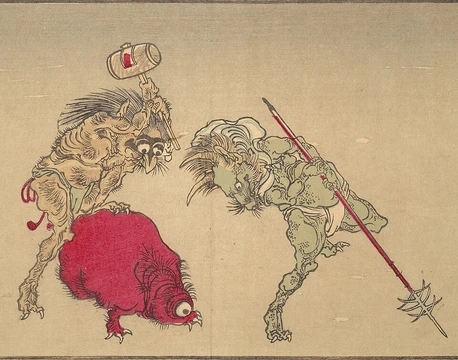
Kibakichi
A youkai swordsman battles demons and humans in Edo Japan.
Kibakichi (牙吉 Bakko Yokaiden Kibakichi) is a 2003 Japanese jidaigeki film directed by Tomoo Haraguchi. The film centers on a youkai swordsman who can transform into a werewolf-like beast and feed on human flesh, set in the Edo period. A sequel followed later the same year in Japan.
- Release Year
- 2003
- Country
- Japan
- Genre
- Jidaigeki (historical), horror, fantasy
- Director
- Tomoo Haraguchi
- Notable Cast
- Ryuji Harada
- Sequel
- Kibakichi 2 (2003)
Lore & Background
In the Edo period, a wandering swordsman wearing a cloak of skins arrives in a gambling town run by demons, led by Boss Ounizo, who hide as humans. Demons (youkai) once lived peacefully alongside humans, but advances in technology—especially the Gatling gun—led humans to nearly wipe them out. Kibakichi uncovers the demons' pact with the human government to secure a sanctuary. He is the likely sole survivor of his wolf clan, which trusted humanity with catastrophic results, making him cautious and untrusting. However, he finds the demon community acts like a close family, including Ounizo's adopted human daughter Kikyo.
Reader's Guide
Kibakichi occupies a niche in early 2000s Japanese cinema as a hybrid of jidaigeki and horror, blending sword fighting with supernatural elements. Director Tomoo Haraguchi, following his film Sakuya (2000), aimed to create a historical piece with extensive swordplay, casting Ryuji Harada for his stage-fighting experience. The film premiered at the San Sebastian Horror and Fantasy Film Festival in 2003, where it was perceived as a major disappointment, with audiences heckling the characters. Critic Bryan Senn described it as a mix of arty cinematography and nightmarish exploitation, noting that the creatures looked goofy but the climactic werewolf action was energetic. The film's legacy is modest, remembered for its unique concept and as a precursor to its sequel, which Haraguchi helped plan but did not direct.
Did You Know?
- The film's director, Tomoo Haraguchi, took only the name Kibakichi and the idea of a masterless samurai who can transform into a werewolf from an existing manga.
- Kibakichi was shown at the San Sebastian Horror and Fantasy Film Festival in Spain in 2003.
- Critic Roberto Curti compared the film's reception to Ju-On: The Grudge, noting both were seen as major disappointments at the festival.
- The sequel, Kibakichi 2, was released in Japan three months after the first film.
The World of Demons and Wolves
In the Edo period, Kibakichi follows a cloak-wearing swordsman who stumbles into a gambling town secretly operated by youkai—demons who disguise themselves as ordinary humans. The film's world is one where supernatural beings and people once coexisted as equals, but the arrival of modern warfare technology, particularly the Gatling gun, shattered that fragile peace. Humans, emboldened by their new destructive capacity, nearly exterminated their once-tolerated counterparts. Kibakichi, the likely last member of a wolf tribe that placed its trust in humanity and paid for it with annihilation, carries that betrayal in every cautious decision. The gambling den he discovers is not merely a den of iniquity but a makeshift family of displaced creatures, including Boss Ounizo, who has taken in a human girl named Kikyo as his own daughter. Beneath the surface of this unlikely household, however, lurks a desperate political maneuver: a secret pact with the ruling government to secure a protected sanctuary. Kibakichi must decide whether to trust those who welcome him or remain the wary, solitary warrior his past demands.
Crafting a Jidaigeki Yokai Tale
Director Tomoo Haraguchi approached Kibakichi as a natural continuation of his 2000 film Sakuya, though the project drew only selectively from an existing manga of the same name. Rather than adapting the source material wholesale, Haraguchi kept the title and the core concept of a masterless samurai capable of shifting into a beast resembling a werewolf, then built everything else from the ground up. His stated ambition was to root the story firmly in the jidaigeki tradition, emphasizing extended sequences of sword combat as a central visual pleasure. Casting Ryuji Harada, already well known to television audiences, served a practical purpose: the demanding tachimawari choreography required performers with genuine stage-fighting experience, and Harada's background in historical period dramas gave him a head start over most of his peers. The result is a film that blends folklore-derived creature design with the physicality of period action cinema, positioning the youkai not as a horror monster but as a displaced warrior navigating a world that has turned against his kind.
A Divided Critical Response
Kibakichi's international debut came at the 2003 San Sebastian Horror and Fantasy Film Festival in Spain, where it shared the bill with Ju-On: The Grudge. Film historian Roberto Curti observed that audiences at the festival treated both films with open mockery, hurling jokes at the characters and among themselves, and he characterized both as significant disappointments for the crowd. Years later, Bryan Senn's entry in The Werewolf Filmography offered a more nuanced reading. He acknowledged the film's tonal inconsistency, describing a collision between deliberate artistic choices—slow-motion frames of trees swaying in the wind, prolonged close-ups of a pensive lead—and visceral exploitation set pieces featuring basements of skulls, partially consumed corpses, and sprays of arterial blood. Senn conceded the creatures read as more comical than frightening and that the film never quite coheres. Yet he singled out the climactic sequence, where the transformed Kibakichi single-handedly tears through a squad of armed human antagonists in a burst of wire-work and stylized carnage, as a moment of genuine kinetic energy that rescues the picture from its otherwise sluggish and fragmented pacing.
Sequel and Afterlife
The momentum of Kibakichi's 2003 Japanese release was quick to follow, with a direct sequel, Kibakichi 2, hitting theaters just three months later. Haraguchi contributed to the planning stages of the follow-up but was ultimately unable to helm it, as his schedule would not permit the commitment. The original film found a wider home on home video when MTI's sub-label Saiko issued a DVD edition on June 28, 2005, making the picture accessible to collectors and genre fans beyond its initial theatrical run. Both the first and second installments maintain dedicated pages on the Saiko Films website, a small but telling sign of the franchise's niche following. For fans of Japanese period horror and werewolf mythology, Kibakichi occupies a curious space: a jidaigeki that leans into exploitation gore, a folklore creature story that prioritizes sword-fighting choreography, and a film whose most praised moments arrive in its most over-the-top, wire-assisted action set pieces. Its brief sequel and limited home-video availability have cemented its status as a cult curiosity rather than a mainstream title.
Gallery
More in Yōkai in popular culture 1-19
Spotted an error? Know more?
This is a living reference — every entry is fact-audited, and reader corrections feed straight into our audit queue. Suggest an edit · See this site's audit record