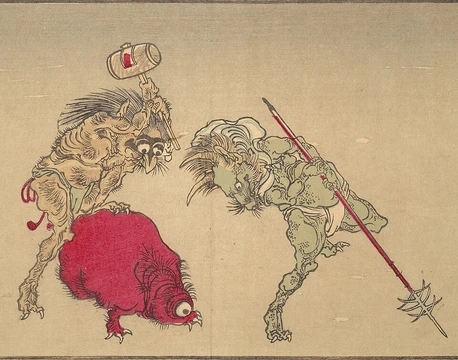
The Great Yokai War
A 2005 Japanese fantasy film about yōkai and a young Kirin Rider.

Wikipedia / Wikimedia Commons
The 2005 Japanese fantasy film *The Great Yokai War* was directed by Takashi Miike and produced by Kadokawa Pictures, with distribution by Shochiku. Its cast includes Ryunosuke Kamiki, Hiroyuki Miyasako, Chiaki Kuriyama, and Mai Takahashi. A loose remake of the 1968 Daiei film *Yokai Monsters: Spook Warfare*, it also draws on Shigeru Mizuki’s *GeGeGe no Kitarō* manga and Aramata Hiroshi’s novel *Teito Monogatari*, whose antagonist Katō Yasunori appears as the main villain. The story centers on yōkai—creatures from Japanese mythology that gained prominence during the Edo period through Toriyama Sekien’s works. Unlike earlier retellings of the Momotarō tale, which often framed native yōkai driving out foreign invaders as nationalist narratives, this film explores the clash between Japan’s traditional landscape and modern culture. This is achieved through the introduction of kikai (machine monsters), created when Katō fuses yōkai with discarded tools and items, and the absence of Western or foreign forces. Mizuki, a key figure in yōkai discourse and culture, served as an advisor and appeared as the Great Elder Yōkai, a cameo that nods to his expertise and echoes his own wartime experiences. The film was released in Japan on August 6, 2005, grossing ¥2 billion, and was released internationally by Tokyo Shock in 2006. An indirect reboot, *The Great Yokai War: Guardians*, followed on August 13, 2021.
The plot follows young Tadashi Ino, who moves to a small town after his parents’ divorce. At a local festival, he is chosen as the Kirin Rider, a protector of all good things. The vengeful spirit Yasunori Katō, empowered by rage over the annihilation of Japan’s local tribes, seeks revenge on modern Japanese for their treatment of yōkai. He allies with the yōkai Agi and summons Yomotsumono, a fiery spirit of discarded things, using it to fuse yōkai with tools into kikai. These kikai capture other yōkai and kill humans. One yōkai, a sunekosuri, escapes and befriends Tadashi, who attempts to obtain the Daitenguken from a mountain as a rite of passage. After overcoming a test set by the sea spirit Shōjō, Tadashi receives the sword from the Daitengu, but it is broken when Agi captures the sunekosuri. Yōkai decide to seek help from the blacksmith Ippondatara, but he is captured. When Katō’s industrial fortress flies toward Tokyo, Tadashi and his companions pursue it. Ippon
- Release Date
- August 6, 2005 (Japan)
- Director
- Takashi Miike
- Production Company
- Kadokawa Pictures
- Distributor
- Shochiku
- Box Office
- ¥2 billion
- Starring
- Ryunosuke Kamiki, Hiroyuki Miyasako, Chiaki Kuriyama, Mai Takahashi
Lore & Background
The film follows a young boy named Tadashi Ino who moves to a small town after his parents' divorce. At a local festival, he is chosen as the Kirin Rider, a protector of all things good. A nefarious spirit named Yasunori Katō, whose powers stem from rage at the annihilation of Japan's local tribes, seeks vengeance against modern Japanese. Katō allies with a yōkai named Agi and summons Yomotsumono, a fiery spirit of discarded things, to fuse yōkai with machines, creating kikai. Tadashi, aided by yōkai such as Shōjō, Kawahime, and Kawatarō, seeks the Daitenguken sword to fight Katō's forces.
Reader's Guide
The Great Yokai War is significant for its retelling of the Momotarō tale, but it shifts focus from nationalist narratives to a clash between Japan's traditional landscape and modern culture, largely due to the use of kikai (machine monsters) and the absence of foreign invaders. Shigeru Mizuki, a key figure in yōkai discourse, served as an advisor and appeared as the Great Elder Yōkai, with his cameo resonating with his manga's themes and his experiences from real war. The film grossed ¥2 billion in Japan and was released internationally by Tokyo Shock in 2006. An indirect reboot, The Great Yokai War: Guardians, was released on August 13, 2021.
Did You Know?
- The film is a loose remake of the 1968 Daiei film Yokai Monsters: Spook Warfare.
- Shigeru Mizuki, a yōkai expert, acted as an advisor and made a cameo as the Great Elder Yōkai.
- The film's antagonist Katō Yasunori is drawn from Aramata Hiroshi's novel Teito Monogatari.
- Daiei Film's tokusatsu characters Gamera and Daimajin are briefly mentioned in the film and its novelization.
Mythological Roots and Literary Lineage
The Great Yokai War does not exist in a vacuum of original invention. Director Takashi Miike's 2005 fantasy film weaves together a remarkable tapestry of Japanese mythological and literary sources. The yokai creatures at the story's center trace their visual and conceptual lineage back to the Edo-period artist Toriyama Sekien, whose catalogues of supernatural beings established the modern vocabulary for these spirits. The film's principal antagonist, Katō Yasunori, is lifted directly from Aramata Hiroshi's novel Teito Monogatari, while the broader spirit of the narrative echoes Shigeru Mizuki's beloved GeGeGe no Kitarō manga. Miike also positions his work as a loose remake of the 1968 Daiei production Yokai Monsters: Spook Warfare, and even drops brief references to Daiei's legendary tokusatsu monsters Gamera and Daimajin. Crucially, all three of these works—the 1968 film, the Aramata novel, and Miike's adaptation—function as modern retellings of the centuries-old Momotarō legend, in which a hero drives demons from a distant island with the aid of animal companions. Produced by Kadokawa Pictures and distributed by Shochiku, the film premiered in Japanese theaters on August 6, 2005, and went on to gross two billion yen.
Tradition Versus the Machine Age
Rather than staging a straightforward battle between Japan and a foreign enemy, The Great Yokai War reframes the classic Momotarō conflict as an internal cultural struggle. The film's central antagonist, Katō, is a demon whose fury is born from the historical annihilation of Japan's indigenous tribal communities. His revenge is not directed at Western invaders but at the modern Japanese society that has displaced and erased the yokai from the landscape. To execute this vengeance, Katō fuses captured yokai with discarded tools and machinery, producing the kikai—literally "machine monsters"—that rampage through the countryside and eventually threaten Tokyo itself. This deliberate absence of external, foreign antagonists distinguishes Miike's vision from earlier adaptations of the Momotarō tale, which have typically been interpreted as nationalist parables of native forces repelling outside threats. Instead, the film interrogates what is lost when a rapidly industrializing nation discards its spiritual heritage, turning the ancient spirits into fuel for a mechanical war machine. The kikai thus become a potent symbol of modernity consuming tradition, and the boy hero's quest to restore balance reads as a plea to remember what the machine age has forgotten.
Mizuki's Ghost in the Machine
Shigeru Mizuki, the manga creator whose GeGeGe no Kitarō series has shaped yokai discourse in both popular culture and academic scholarship for decades, lent his name and presence to The Great Yokai War in a capacity that went far beyond a simple endorsement. He served as a formal advisor on the production, ensuring the film's treatment of yokai respected the depth of the tradition he helped popularize. More memorably, Mizuki appeared on screen as the Great Elder Yōkai, a role that functions as both a tribute to his status as the preeminent yokai authority and a thematic anchor for the film's closing message. His final words in the movie echo the philosophical underpinnings of his own manga, reinforcing the idea that coexistence between humans and spirits is not merely a plot device but a moral imperative. The character's identity as a peace-keeper is a motif that runs throughout Mizuki's body of work, a sensibility rooted in his own lived experience of wartime destruction. By embedding this figure into the narrative, Miike bridges the gap between a veteran cartoonist's lifelong meditation on Japanese folklore and a blockbuster fantasy film aimed at a new generation of viewers.
A Boy, a Sword, and a Bittersweet Farewell
The narrative engine of The Great Yokai War is the unlikely heroism of Tadashi Ino, a young boy who, after his parents' divorce, relocates to a small town and is chosen as the year's Kirin Rider—a title tied to the Qilin, the legendary protector of all good things. What begins as a ceremonial honor quickly becomes literal when the demon Katō unleashes his army of kikai across the countryside. Tadashi's journey to retrieve the Daitenguken sword from a haunted mountain, aided by the sea spirit Shōjō, the river maiden Kawahime, and the bumbling bean spirit Azukiarai, sets the stage for a battle that culminates in Tokyo, where Katō's industrial fortress has swallowed the Shinjuku Capital Building. The climax is won not through martial prowess but through an absurd accident: a single adzuki bean from Azukiarai, mixed into the final fusion, triggers a cascade of positive emotion that shatters the monstrous Yomotsumono. Yet the film's final image is quietly devastating. Years later, the grown Tadashi can no longer see yokai at all, and the sunekosuri who befriended him is confronted by a Katō whose eyes now hold Azuki pupils—a haunting reminder that the war's echoes never truly end.
Gallery
More in Yōkai in popular culture 1-19
Spotted an error? Know more?
This is a living reference — every entry is fact-audited, and reader corrections feed straight into our audit queue. Suggest an edit · See this site's audit record