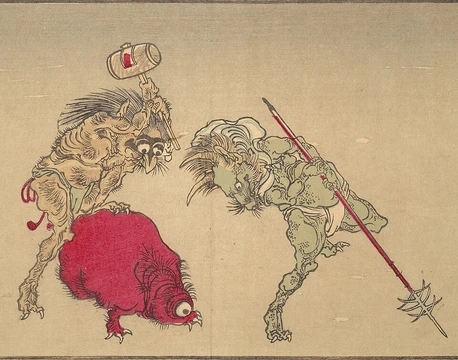
Dororo (film)
A dark fantasy film based on Osamu Tezuka's manga.

Wikipedia / Wikimedia Commons
Dororo is a 2007 Japanese dark fantasy action film adapted from Osamu Tezuka's 1960s manga. Filmed in New Zealand, it diverges notably from the original story, particularly by aging up its two main characters.
**Plot**
Dororo is a young woman who poses as a man, though her rough and violent manner often gives her away. After her father was killed by the warlord Daigo for challenging him, she and her mother fled into the wilderness. On her mother's deathbed, Dororo was told to carry on her father's vendetta against Daigo, so she adopted a male identity and grew up homeless and friendless, becoming a thief to survive. She never used a name, believing that nameless thieves could not be tracked or caught. Only after traveling with Hyakkimaru does she choose the name "Dororo," which he had picked up on his journeys and explained meant "Little Monster." She felt it fit her better, while Hyakkimaru kept his own name.
Hyakkimaru was abandoned at birth after his biological father sold his body to demons, leaving him without 48 body parts. He survived because a master spellcaster took pity on him and replaced the missing parts with those of dead children. From childhood, Hyakkimaru attracted an unusual amount of supernatural attention, especially from evil spirits. This led to the death of his adoptive father, leaving him emotionally shattered. He then set out to destroy the demons and reclaim his stolen body.
Among the demons Hyakkimaru faces are a Jorōgumo, a moth demoness named Maimai´Onba who kidnapped abandoned children to feed her half-breed offspring, a cherry blossom tree monster, and a lizard monster. After killing a Daitengu and regaining his right arm, Hyakkimaru learns that his curse was arranged by his birth father—Daigo himself. When he kills a pair of dog demons tormenting him about this, he gains his real eyes. At dawn, he is confronted by Tahōmaru, the man he learns is his younger brother. Tahōmaru, jealous of their mother's affection for Hyakkimaru, attacks and is accidentally killed.
Daigo then arrives and cuts down his wife as she tries to persuade him to spare Hyakkimaru, their only remaining son. Hyakkimaru nearly kills his father but spares him, urging him to create the utopia he once dreamed of. However, Daigo sells his body to one of the demons from the original pact in exchange for Tahōmaru's return. Dororo warns him that the demon will
- Release year
- 2007
- Country
- Japan
- Genre
- Dark fantasy action
- Based on
- 1960s manga series by Osamu Tezuka
- Director
- Not specified in source
- Lead actors
- Satoshi Tsumabuki, Kō Shibasaki, Eita Nagayama
Lore & Background
The film follows Dororo, a young woman who assumes a male identity after her father is killed by the warlord Daigo. At her mother's dying request, she carries on her father's vendetta, living as a thief without a permanent home. She eventually takes the name 'Dororo' from Hyakkimaru, who had acquired it during his travels. Hyakkimaru was abandoned at birth and his body sold to demons by his birth father, resulting in his lacking 48 body parts. A master spellcaster replaced his missing parts with those of deceased children. Hyakkimaru quests to destroy the demons and regain his stolen body, encountering creatures such as a Jorōgumo, a moth demoness, a cherry blossom tree monster, and a lizard monster. He learns that his curse was his birth father's doing and that man is Daigo. After killing a Daitengu and regaining his right arm, he gains his real eyes and later accidentally kills his younger brother Tahōmaru. Daigo sells his body to a demon to revive Tahōmaru, but Daigo holds the monster at bay so Hyakkimaru can kill him, restoring Hyakkimaru's heart. Hyakkimaru declines the throne and continues with Dororo to kill the remaining demons.
Reader's Guide
The film adapts Tezuka's classic manga with notable changes, including aging up the protagonists. It explores themes of identity, vengeance, and redemption through the journey of Hyakkimaru and Dororo. The film's New Zealand shooting locations provide a distinct visual backdrop. Its cast includes prominent Japanese actors such as Satoshi Tsumabuki and Kō Shibasaki. In 2012, a Western adaptation was announced by producer Ernesto Foronda. The film remains a notable entry in Japanese fantasy cinema, blending dark themes with action and supernatural elements.
Did You Know?
- The film was shot in New Zealand.
- Hyakkimaru and Dororo are significantly older than their manga incarnations.
- Hyakkimaru's body was sold to demons by his birth father, resulting in his lacking 48 body parts.
- In 2012, a Western adaptation was announced by producer Ernesto Foronda.
Adaptation & New Zealand Production
The 2007 film Dororo draws its narrative foundation from Osamu Tezuka's celebrated 1960s manga series, yet the cinematic version departs from the source material in ways that fundamentally reshape the story. One of the most notable alterations is the age of the two central characters: Hyakkimaru and Dororo are portrayed as significantly older than their manga counterparts, lending the film a more mature, world-weary tone to what could have been a coming-of-age tale. The production was shot in New Zealand, a choice that gave the dark fantasy action film a distinct visual landscape separate from traditional Japanese settings. Despite these creative liberties, the film retains the core mythic structure of Tezuka's work—body-snatching demons, a warlord's fatal bargain, and a road of vengeance—while recontextualizing them through a lens that feels both contemporary and deeply personal. The result is a film that honors its legendary source while asserting its own identity as a standalone cinematic experience.
Character Journeys & Thematic Core
At the heart of the film are two protagonists whose backstories are defined by loss and displacement. Dororo is a young woman who has assumed a male identity after her father was slain by the warlord Daigo during a failed challenge. Her mother, dying in the wilderness, entrusted her child with an impossible vendetta, and so the girl grew up stateless, friendless, and nameless—surviving as a thief who understood that revealing one's name invited capture. It is only after traveling alongside Hyakkimaru that she claims the name "Dororo," a label he had once used for himself, meaning "Little Monster." Hyakkimaru's tragedy is equally profound: his birth father sold his body to demons, leaving him without forty-eight parts. A compassionate spellcaster saved his life by grafting the limbs of deceased children onto his frame. From childhood, his supernatural magnetism drew malignant spirits, and the death of his adopted father set him on a relentless quest to destroy the demons and reclaim his stolen flesh.
Climactic Confrontation & Resolution
The film's final act delivers an emotionally devastating sequence in which Hyakkimaru's quest collides with his own family. After slaying a Daitengu and recovering his right arm, he discovers that the man who sold his body to demons is none other than Daigo, his birth father. This revelation is compounded when he encounters Tahōmaru, his younger brother, whose jealous rage over their mother's affection escalates into a fatal confrontation in which Hyakkimaru accidentally kills him. Daigo arrives and, in a moment of brutal indifference, cuts down his own wife as she pleads for her surviving son's life. Though Hyakkimaru comes within a breath of killing his father, he spares him and instead urges him to build the utopia he once promised. Daigo, however, sells his body to a demon in exchange for Tahōmaru's resurrection. Dororo warns him of the catastrophe this will bring, but he proceeds regardless. In the ensuing battle, Hyakkimaru kills Daigo and regains his heart—yet the pain in his chest lingers, signaling that he has felt remorse for the first time. He ultimately declines the throne and continues his journey with Dororo to destroy the remaining two dozen demons.
Cast & Western Remake Ambitions
The 2007 film assembled a notable ensemble of Japanese actors to bring Tezuka's dark fantasy to life. Satoshi Tsumabuki takes on the role of Hyakkimaru, the demon-slaying protagonist whose body has been pieced together from the remains of deceased children. Kō Shibasaki portrays Dororo, the brash and violent thief who hides her true identity behind a male persona. Eita Nagayama appears as Tahōmaru, the younger brother whose resentment drives one of the film's most tragic confrontations. Kiichi Nakai embodies Lord Kagemitsu Daigo, the warlord whose fatal bargain with demons sets the entire narrative in motion. Supporting roles include Yoshio Harada as Jukai, Mieko Harada as Yuri, Katsuo Nakamura as Bipa, and Tetta Sugimoto as Sabame. Beyond the film's initial release, Dororo's narrative continued to attract international interest. In 2012, it was announced that Ernesto Foronda, the producer behind Better Luck Tomorrow, was set to develop a Western adaptation of the story, signaling that the film's mythic core still resonated well beyond its original Japanese audience.
Gallery


More in Yōkai in popular culture 1-19
Spotted an error? Know more?
This is a living reference — every entry is fact-audited, and reader corrections feed straight into our audit queue. Suggest an edit · See this site's audit record