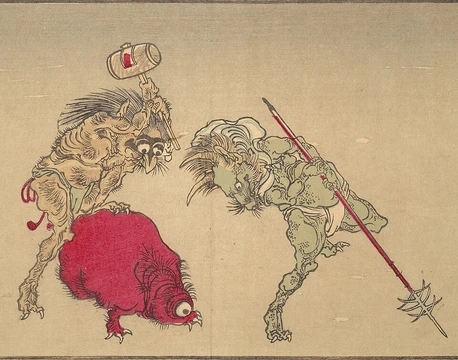
Yōkai Dochuki
1987 Namco arcade platformer set in Buddhist hell.
Yōkai Dōchūki is a platform game from Namco, first released in Japanese arcades in April 1987 and later that year in other parts of Asia. The player controls Tarosuke, a boy exiled to "jigoku" (hell) for causing trouble in the living world, who must travel through five monster-filled levels—such as the Gateway to Hell and the Ghost Sea—to reach Yama, the Buddhist judge of the dead, who decides his fate. Tarosuke shoots small "ki" bullets at enemies, which can be charged by holding down the joystick or directional pad for more power. Defeated enemies drop money bags, used to buy items at in-game stores. The game ends when Tarosuke's life bar is depleted.
The first four levels end with a boss fight against an oni. Before each fight, Tarosuke kneels at a shrine to summon a spirit named Monmotaro, whom the player controls to fly and fire powerful energy pellets. Difficulty increases as the game progresses; some levels require finding three secret items to unlock the next area, and hidden pathways must be discovered. The final level's ending—one of five—depends on the money collected and enemies killed, ranging from Tarosuke reaching heaven to being sent back to hell. The Family Computer version adds a "pious" meter, filled by completing good deeds like specific objectives, which also influences the ending.
The game was ported to the PC Engine and Family Computer with added content and redesigned levels. Both the arcade and PC Engine versions later returned on the Wii's Virtual Console. In April 2022, Hamster Corporation released it for Nintendo Switch and PlayStation 4 through their Arcade Archives series. A Japan-only spin-off, Kyūkai Dōchūki, followed in 1990; it is a baseball game similar to Namco's World Stadium series. Tarosuke appears as a playable character in the Japan-exclusive PlayStation 2 RPG Namco X Capcom, teamed with Taira no Kagekiyo from Genpei Tōma Den, and makes a cameo in Project X Zone 2 for the Nintendo 3DS.
In April 1987, Game Machine reported Yōkai Dōchūki as the most popular arcade game that month, and it became the fifth highest-grossing table arcade game in Japan for 1987.
- Developer
- Namco
- Publisher
- Namco
- Platform
- Arcade (original), PC Engine, Family Computer, Wii Virtual Console, Nintendo Switch, PlayStation 4
- Release Year
- 1987
- Genre
- Platform video game
- Region
- Japan and other parts of Asia
Lore & Background
In Yōkai Dōchūki, the player controls Tarosuke, a boy banished to 'jigoku' for causing mischief in the world of the living. Tarosuke must venture through monster-infested jigoku to reach Yama, the Buddhist deity that judges the dead, who determines his final fate. The game is divided into five levels, each taking place in specific regions of jigoku, such as 'Jigoku Iriguchi' (The Gateway to Hell) and 'Yuukai' (The Ghost Sea). Tarosuke must reach the end of these levels while defeating enemies and jumping onto platforms. He can defeat enemies by shooting small 'ki' bullets; these can be charged to increase their power by holding down on the joystick or directional pad. Enemies drop bags of money when killed, which is used to purchase useful items at stores. Tarosuke has a life bar that depletes when he is inflicted with damage; the game ends when the meter is empty.
The first four stages conclude in a boss fight with an oni that guards the entrance to the next stage. At the beginning of these, Tarosuke kneels at a shrine and summons a spirit named Monmotaro to defeat the oni. The player controls Monmotaro in these fights, being able to fly around and shoot powerful energy pellets. The game increases in difficulty as Tarosuke progresses, with some levels requiring him to find three secret items in order to unlock the way to the next area and search for hidden pathways. The amount of money collected and enemies killed in the final level determines which of five endings the player receives, with the best showing Tarosuke traveling to heaven, and the worst ending showing Tarosuke sent back to Hell. The Family Computer version of the game adds a 'pious' meter, which is filled when Tarosuke performs good deeds such as complete specific objectives in some levels. The pious meter also helps to determine the ending received at the end of the game.
Reader's Guide
Yōkai Dōchūki was the most-popular arcade game in the month of April 1987 according to Game Machine, and went on to be the fifth highest-grossing table arcade game of 1987 in Japan. It was followed by a Japan-only spin-off in 1990 named Kyūkai Dōchūki, a baseball video game that plays similar to Namco's own World Stadium series. The game's protagonist Tarosuke appears as a playable character in the Japan-only role-playing PlayStation 2 game Namco X Capcom, where he is teamed up with Taira no Kagekiyo from Genpei Tōma Den. He also makes a cameo appearance in Project X Zone 2 for the Nintendo 3DS. The game's legacy includes multiple re-releases across various platforms, including the Wii Virtual Console and the Arcade Archives series for Nintendo Switch and PlayStation 4, ensuring its continued availability to modern audiences.
Did You Know?
- The game was the most-popular arcade game in Japan in April 1987.
- It was the fifth highest-grossing table arcade game of 1987 in Japan.
- The Family Computer version adds a 'pious' meter that helps determine the ending.
- Tarosuke appears as a playable character in Namco X Capcom for PlayStation 2.
More in Yōkai in popular culture 1-19
Spotted an error? Know more?
This is a living reference — every entry is fact-audited, and reader corrections feed straight into our audit queue. Suggest an edit · See this site's audit record