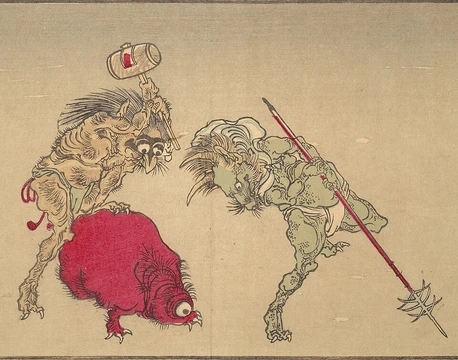
Yokai Monsters: Spook Warfare
A 1968 Japanese fantasy horror film featuring yōkai monsters.
Yokai Monsters: Spook Warfare (Japanese: 妖怪大戦争, Yōkai Daisensō; literally "The Great Yokai War") is a 1968 Japanese fantasy horror film directed by Yoshiyuki Kuroda. It is the middle installment of a trilogy from the late 1960s centered on traditional Japanese monsters called yōkai. The first film was *Yokai Monsters: 100 Monsters* (1968), and the third was *Yokai Monsters: Along with Ghosts* (1969). Produced by Daiei Film, the movie relies heavily on tokusatsu special effects, with most creatures portrayed by actors in costumes or puppets. It was shot in Fujicolor and Daieiscope. In 2005, director Takashi Miike released *The Great Yokai War*, a modern retelling that borrows many elements from this film.
The story begins in the ruins of the Babylonian city of Ur, where a local legend tells of a dormant monster named Daimon. Four thousand years later, two treasure hunters disturb the ruins, awakening Daimon, who kills them with a landslide. He then flies to Japan, where he encounters a samurai named Lord Hyogo Isobe, kills him, and drinks his blood. Taking Isobe’s form, Daimon goes to the lord’s house, meets his daughter Lady Chie and samurai Shinpachiro Mayama, kills the family dog for barking, and orders all altars torn down and burned. In his frenzy, he throws an ornament into a pond, rousing a kappa. The kappa investigates, sees Daimon (as Isobe) drinking the blood of steward Saheiji Kawano, and attacks but is defeated. Hurt, the kappa seeks help from other yōkai in the woods: the one-legged Kasa-obake, the frightening Futakuchi-onna, the long-necked Rokurokubi, the clay monster Nuppeppō, and the wise Abura-sumashi. They doubt the kappa’s story, citing a field guide and coloring book about yōkai.
Meanwhile, Lady Chie and Shinpachiro find maid Shinobu, a victim of Daimon’s vampirism. Shinpachiro consults his uncle, a priest, who reveals that Isobe is dead and a demon impersonates him. The priest gives Shinpachiro three candles to place around the demon while he chants destruction prayers. Though Shinpachiro sets the candles correctly, Daimon kills the priest by reversing the magic. Daimon, thirsting for younger blood, goes with his retainers to find children. He attacks a family, but the parents slip their children out the back door before being killed. The children bump into the kappa and yōkai at a “monster’s shrine.” Realizing their error, the yōkai a
- Release Year
- 1968
- Director
- Yoshiyuki Kuroda
- Studio
- Daiei Film
- Country
- Japan
- Genre
- Fantasy horror
- Format
- Fujicolor, Daieiscope
- Series Position
- Second in a trilogy (preceded by Yokai Monsters: 100 Monsters, followed by Yokai Monsters: Along with Ghosts)
Lore & Background
The film opens in the ruins of the Babylonian city of Ur, where a monster named Daimon is roused by treasure hunters and flies to Japan. There, it kills a samurai, Lord Hyogo Isobe, and assumes his form. Daimon tears down altars and drinks blood, rousing a kappa who seeks help from other yōkai. The yōkai initially disbelieve the kappa, citing a field guide and coloring book, but later join forces after Daimon attacks a family. The yōkai, including Kasa-obake, Futakuchi-onna, Rokurokubi, Nuppeppō, and Abura-sumashi, battle Daimon and his clones, ultimately defeating him by stabbing his remaining eye.
Reader's Guide
Yokai Monsters: Spook Warfare is significant for its extensive use of tokusatsu special effects and its focus on yōkai as playful, heroic figures, contrasting with their usual frightening portrayal in kaidan tales. The film has been the subject of numerous academic essays on yōkai in modern media, with references by scholars such as Zilia Papp and Michael Dylan Foster. Its costumes and puppets are among the most recognizable realizations of traditional yōkai illustrations in cinema. The film also influenced Takashi Miike's 2005 remake, The Great Yokai War, which borrows many elements from Spook Warfare. Critics have praised the special effects but noted a clash between the film's violent, frightening content and its child-friendly tone.
Did You Know?
- The film was made in Fujicolor and Daieiscope.
- The monster Daimon is roused from the ruins of the Babylonian city of Ur.
- The yōkai initially disbelieve the kappa's story, citing a field guide and a coloring book about yōkai.
- In 2005, director Takashi Miike released a modern retelling titled The Great Yokai War.
More in Yōkai in popular culture 1-19
Spotted an error? Know more?
This is a living reference — every entry is fact-audited, and reader corrections feed straight into our audit queue. Suggest an edit · See this site's audit record