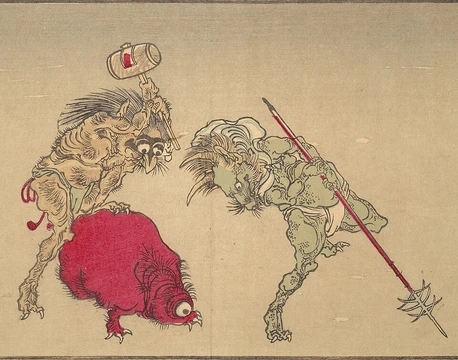
Yokai Monsters
A trilogy of Japanese yōkai films from the late 1960s.
Yokai Monsters is a trilogy of Japanese horror/fantasy films written by Tetsuro Yoshida and released in the late 1960s. Produced by Daiei Film, the productions were largely influenced by the Gamera and Daimajin franchises, with minor references among these franchises inserted on various occasions. The films are thematically joined by their inclusion of yōkai, creatures from Japanese mythology.
- field
- Film
- nationality
- Japanese
- known_for
- Trilogy of horror/fantasy films featuring yōkai
- producer
- Daiei Film
- writer
- Tetsuro Yoshida
- release_years
- 1968–1969
Lore & Background
The Yokai Monsters trilogy consists of three films: Yokai Monsters: 100 Monsters (March 1968), Yokai Monsters: Spook Warfare (December 1968), and Yokai Monsters: Along with Ghosts (March 1969). While not canonically linked, all three are thematically joined by their inclusion of a group of creatures from Japanese mythology known as yōkai. The films were produced by Daiei Film and written by Tetsuro Yoshida, with productions largely influenced by the Gamera and Daimajin franchises.
Reader's Guide
Receiving little attention outside Japan, the Yokai Monsters films are remembered mainly for their special effects, which include puppetry, suitmation, and traditional animation. The puppet used for the Kasa-obake in particular has become a recognizable rendering of the creature. Involvement of Shigeru Mizuki, Hiroshi Aramata, and Natsuhiko Kyogoku resulted in crossovers with the Teito Monogatari series and the GeGeGe no Kitarō franchise. Kazuo Umezu also associated with the franchise, and his manga-based 1968 film The Snake Girl and the Silver-Haired Witch was distributed along with Yokai Monsters: Spook Warfare. In 2005, Takashi Miike directed a remake of Spook Warfare titled The Great Yokai War, which draws influence from similar sources. A sequel, The Great Yokai War: Guardians, was released in 2021, featuring Daimajin, with Gamera appearing in its spinoff novelization. Other related films include Yōkai Heaven and its sequel, redeveloped from reboot attempts by Daiei Films and Tokuma Shoten.
Did You Know?
- The trilogy consists of three films released between March 1968 and March 1969.
- The puppet used for the Kasa-obake has become a recognizable rendering of the creature.
- Kazuo Umezu's 1968 film The Snake Girl and the Silver-Haired Witch was distributed along with Yokai Monsters: Spook Warfare.
- Takashi Miike's 2005 film The Great Yokai War is a remake of Yokai Monsters: Spook Warfare.
More in Yōkai in popular culture 1-19
Spotted an error? Know more?
This is a living reference — every entry is fact-audited, and reader corrections feed straight into our audit queue. Suggest an edit · See this site's audit record